|
Extended Models |
|
This
page introduces several extended models of the latent rank theory (LRT) /
neural test theory (NTT). |
|
Although
the item category reference profile (ICRP) expressing the statistical
characteristics of each item category, is mainly introduced here, the test
reference profile (TRP), latent rank distribution (LRD), rank membership
profile (RMP), rank membership distribution (RMD), and observation ratio
profile (ORP) described on the “Features” page can be also
obtained by analysis using polytomous LRT models. |
|
The
Bayesian estimation method, a monotonically increasing constraint, and
missing data treatment can be implemented in the statistical learning process
of polytomous LRT models. Additionally, test equating can be performed using
polytomous models. |
|
Graded Latent Rank Model |
|
The graded latent rank (LRT) model or the graded neural
test (GNT) model is an LRT/NTT model for analyzing ordered polytomous data.
It is useful for analyzing testlet items and Likert-type variables of
psychological questionnaires. This model reduces the dichotomous LRT model when the number of
categories is two.
These
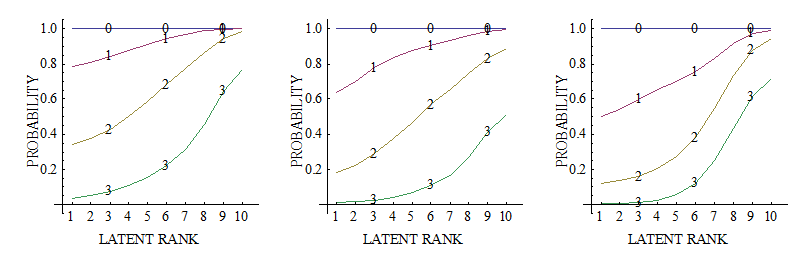
example boundary category reference profiles (BCRPs) of
the GLR model that are useful for reviewing the behavior of the probability
of selecting each item category or higher category through the latent rank
scale. A monotonically increasing constraint can be imposed on the BCRPs.
These
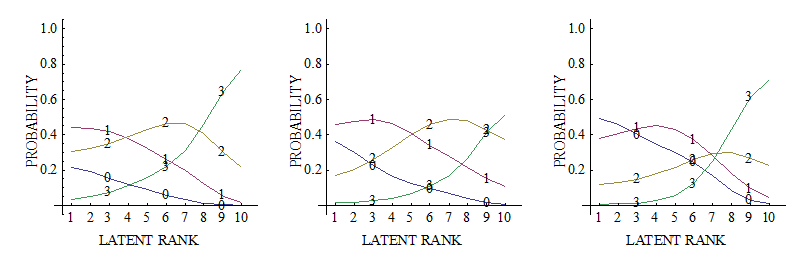
example item category reference profiles (ICRPs) of
the GLR model express the probability of selecting each item category. They
show that examinees in higher latent ranks generally select higher
categories. |
|
Nominal
Latent Rank Model |
|
The nominal latent rank (NLR) model or the nominal neural
test (NNT) model is a polytomous LRT/NTT model for analyzing
nominal-polytomous data. The NLR model is used for evaluating the statistical
feature for incorrect choices of multiple-choice items. This model reduces the dichotomous LRT
model when the number of categories is two.
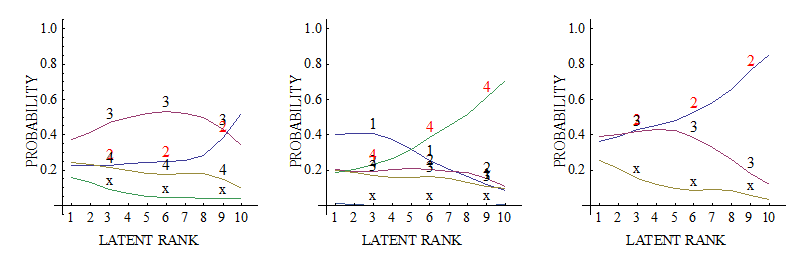
These are example ICRPs of the NLR
model. The profiles with red numbers are the correct-answer ones. The lines
labeled “x” represent the merger of categories for which the
selection ratios were less than 10% for examinees. These plots show that the
ICRPs for the correct answers increase with the latent rank. The
monotonically increasing constraint can also be imposed on the ICRPs for the
correct answers. The ICRPs of the NLR model can clarify the statistical
characteristics of the analyzed items, for example, the existence of
attractive incorrect choices for examinees in lower latent ranks or the
existence of items with virtually two alternatives. |